Pyrolysis
Municipal Solid Waste (MSW)
The plant performance is
related to the composition of feedstock input (calorific value and moisture
content). Average MSW content varies from country to country since there is the
difference in climate eating patterns, and initial sorting of waste.
Due to the built-in design features, the MPSC system successfully accommodates
sudden fluctuations in the waste quality from its average value, which occur
within the facility.
This pyrolysis system for treatment of MSW and other wastes
demonstrates excellent practical performance in controlling the emission of
harmful substances such as dioxins with levels dramatically lower than
regulation values. No special chemicals, which may have impact on the overall
environmental performance, are required for the process.

The MPSC plant does not produce waste water effluent from the gas cleaning
system. Along with this obvious environmental advantage it also makes the system
less expensive. Another environmental aspect is the reduction of the residuals.
Solids after the treatment at the facility can be used in the building industry.
Typically 100 tpd plant treating MSW with a calorific value of 8,4 MJ/kg and
moisture 40% (thermal energy from wastes ~ 9,72 MWh) the MPSC process generates
2 MW of electricity. Consequently the MPSC process will annually generate ~15,6
GW gross electrical output and ~11,7 GW of net electrical energy is supplied to
the grid (325 days operation per annum)
WPP SynEnergy System
The
WPP SynEnergy System Composting MBT front-end, to produce a high purity compost,
followed by a pyrolysis stage to cleanly convert any synthetics to electrical
energy. This results in an in-vessel MBT system that is energy self-sufficient
and exports a significant amount of clean electrical power.
The
use of pyrolysis to reduce the synthetic materials to a clean gas ensures that
any pollution is minimal and that dioxins and furans are not produced. The
conversion of biomass to compost and synthetics to energy, results in a facility
that provides high quality, organic-rich soil conditioner without the need for
external power and greatly increase WPP landfill diversion which can be as high
as 90%, dependent upon the waste stream.
The
MBT front-end ensures that recyclable materials can be cleanly recovered. The
WPP SynEnergy System is particularly suitable for areas of poor soil quality
where the true value of compost will be recognized and valued.
WE MANAGED TO CREATE A MIRACLE OUT
OF SCRAP TIRES
Solid wastes threaten human health as well as causing environmental pollution.
Developed countries fund research and development studies that aim to eliminate
solid wastes of environment and the most effective method is recycling since it
creates an additional economic value out of waste while cleaning the
environment.
Although solid waste reminds the concept of household garbage, in today's world
scrap tires are one of the most dangerous wastes that requires urgent
precautions to be taken against. Worn-out, damaged, old and defaulted tires are
classified as waste or scrap tires and are;
Flammable (petroleum
derivative and hard to extinguish when under fire),
High in volume (huge dimensions and stocking covers broad areas),
Poisonous (release poisonous gases while burning),
Scattered in environment (lack of specific gathering areas; left to garbage
dumps, road sides, gas stations, various kinds of empty territories)
And because of these reasons, scrap tires are dangerous wastes that need to be
paid attention to. The amount of scrap tires in many different countries are
expressed in millions of tons.
Scrap tires are;
Burned (to obtain thermal energy which is extremely poisonous),
Left to garbage dumps,
Used as barriers,
Granulized,
Grazed to be used as shoe-sole material (only exterior part of tire is grazed).
Those are the most common methods to evaluate scrap tires. But none of these are
capable of totally eliminating the scrap tire problem. Granulizing is the
process that diminishes the certain rubber-based parts of the tire into small
pieces but since the granulizing process does not compromise the whole tire,
considerable amount of tire is left as scrap, therefore
GRANULIZING IS NOT A RECYCLING
OPERATION.
The evaluation methods listed above contribute to the reduction of the amount of
waste tires but can never be a long-term and permanent solution to waste tire
problem. This pessimistic picture caused environmental organizations,
universities, research institutions and private entrepreneurs like us to conduct
research and development studies over the recycling methods concerning scrap
tires.
WPP has assembled
the first and only PYROLYSIS WASTE TIRE RECYCLING FACILITY by using its own
equity after 3 years of research and development studies over the technique
known as PYROLYSIS which is mainly practiced in universities and laboratories in
experimental scales.
The SYSTEM developed by
WPP.
Provides 100% scrap
tire recycling (no waste left after the process is completed),
Does not use any chemical ingredients in the process (environment friendly),
Does not cause air, soil and water pollution
Creates economically valuable products out of waste (all of the products are
industrial raw materials that have market values),
OUR SYSTEM
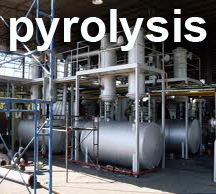
Pyrolysis process is the thermal decomposition of organic materials in an
oxygen-free environment and is an endothermic reaction. It requires an input of
heat energy, pressure and pre-determined temperature depending on the organic
material to be pyrolized.
Pyrolysis process
has phases and in each phase different decompositions originate therefore
different products (steam, gas, oil, etc.) are obtained. Phases of the process
are determined by the process temperature, pressure, duration, and the variety
of organic materials to be processed (scrap tire, plastic bottles, medical
waste, etc.).
WPP'ss recycling
technology is based on the implementation of pyrolysis on waste tires. The
optimum phase durations, temperatures, pressures, vacuum levels, amount of waste
tire to be processed and other side factors are determined by BAHAR END.s 4
years of experience of research and several laboratory applications.
What makes WPP different in waste
tire recycling?
-
100% waste tire
recycling is achieved (no churn left after the process).
-
No chemical
ingredients are used in process (environment friendly).
-
During and after
the process; no soil, water or air pollution is observed.
-
Creates
economically valuable products out of waste (all of the products are
industrial raw materials that have a market value).
-
The most
cost-effective waste tire recycling technology in the world.
-
Raw material
(waste tire) is cheap and easy to provide.
-
The system is
applicable for the waste tire components (rubber dough, used rubber,
granulated rubber, etc.) which are the by-products of tire production.
-
Each recycled
ton of tire preserves 10 tons of CO2 that is a major greenhouse gas.
-
The recycling
facility can be constructed and ready to be operated in 6 months.
-
The process can
be applied to all rubber based materials.
-
The system
creates an alternative source of energy to replace petroleum products and
natural gas.
-
System gives the
opportunity to governments and local administrations to deal with the waste
tire problem to a great extent.
-
System prevents
the spread of diseases caused by waste tires.
WPP's pyrolysis
process duration ranges from 4 to 12 hours depending on the amount and type (car
tire, truck tire, etc.) of the recycled tires. During the process different
vacuum values are applied in pre-determined temperatures and obtained gases in
different phases are channeled to coolers and the condensed gas is stored as
fuel-oil in tanks.
The non-condensable
gases have a high calorific value and could be used as energy resource in
burners for thermal energy production. Detailed research and development studies
for the evaluation of non-condensable gases are being carried out.
Carbon black and steel wire mixture obtained as the result of the pyrolysis
process is sieved and separated by magnets and carbon black is dispatched to
grinding section to be crumbed to 30-40 micron size.
Finally packaging
takes place. Steel wires are stored in waste steel gathering area.
The outcome of pyrolysis process depending on the type and amount of waste tire
is as follows:
-
35%-42% fuel oil
-
35%-45% carbon
black
-
12%-15% steel
wire
-
7%-8% gas
Waste Gasification
|
Biomass Gasification
|
Plasma Gasification
|
Bio-fuel & Power
|
Potable Water |
Pyrolysis |
Financing |
About us |
Contact us

|